


Yes, we're here with our bikes! The ultimate Liebesgut bike guide for you and your dog
The sun is shining and you want to get straight on your bike for a ride with the dog? Don't be too hasty. Because there's a lot to consider when cycling with a dog. Here's our ultimate guide from the experts.
Preparation is everything: four tips for preparing for your first bike ride
- The dog should be fully grown and fit: If the dog is too young, the constant strain would be too much for their immature bones and joints. If in doubt, consult your vet. If there are any injuries or changes to the musculoskeletal system, you should be careful. There should also be a minimum level of discipline so that the animal can be led properly on the bike. If the dog is already unfocussed when being walked and does not follow commands, you should refrain from cycling for the time being.
- Slowly familiarise your dog with the bike: Many dogs find the bike threatening, often due to bad experiences in road traffic. Push the bike back and forth in a safe, quiet place where nobody else is in the way. Pay attention to how your dog reacts. If the dog reacts anxiously to the bike, leave it and kneel down next to it. Offer your pet a treat and make sure that he accepts it near the bike. It is best to combine this with a command, such as "bike". In future, the dog should then approach the bike independently on this command.
- Lead the dog on the right side of the bike: This side is usually the side facing away from traffic and therefore the safest for your pet. Often there are also grass verges on this side, which is of course gentler on paws than tarmac. The dog should therefore go to the right side of the bike on the command "bike". This must be practised extensively before moving on to the next steps.
- Rehearse commands: In order to be safe on the road, the commands for slow, faster, left and right and stop should be firmly anchored in the dog's repertoire. To practise the commands, you need a place without traffic and other distractions. This could be your driveway or a deserted supermarket car park on a Sunday. To start with, you push the bike and your dog walks to the right of you at the height of the rear wheel. It is important that you first slow down or steer to the right, for example, and then give the appropriate command "slow" or "right". The safest area for your pet is at the height of the rear wheel. If it runs alongside you here, it can recognise changes of direction on the bike early enough and react accordingly. It is also important to ensure that the dog does not look at you when given a command, but always looks in the direction of travel. If the animal is distracted by the commands, this can be a considerable danger in road traffic. You yourself should also be able to trust that your commands will be carried out. If you have to check every time that your commands are being carried out by the animal, this poses a safety risk in traffic.
- Clarify how the dog is secured to the bike: It is best to seek advice from a specialist dealer. The following points must be observed in any case:
- No inseparable connection between animal and bike with conventional leads. If, for whatever reason, force is exerted on the lead, the connection should automatically disconnect from the bike. Imagine that a pedestrian or lamp post comes between you and your dog. The sudden pull on the lead can cause your dog to strangulate and you will almost certainly fall with the bike. So never simply wrap the lead around the handlebars.
- Keep the distance between the dog and the bike neither too long nor too short. If the distance is too short, there is a risk that the dog will run into the bike. If the distance is too long, there is a risk of objects getting between the dog and the bike.
- Do not use flexi leads. The dog should not be tempted to increase the distance to the bike on its own.
- Always attach the dog to the bike in road traffic. Only in areas without car traffic, e.g. field or forest paths, can the dog run freely next to the bike.
- A chest harness is preferable to a collar. The pressure is distributed more evenly with a chest harness and prevents injuries and chafing.
And off you go
Start with short distances and slowly get your dog used to longer tours. Always pay attention to the surface on the routes. Tarmac can put a lot of strain on your dog's paws in the long run, especially in summer when it's really warm. The tar can heat up to high temperatures and in extreme cases can even lead to blisters. Paths made of earth or with a grassy centre strip are better. In summer, you should also always carry water for your dog so that he can drink something on the way. There are very practical collapsible bowls that are space-saving to transport. If it is very hot, you should refrain from cycling or only cycle in the shade, e.g. in wooded areas.
It's the speed that counts
The speed should also be kept moderate at the beginning. Increase it slowly when you realise that your dog can easily keep up. However, avoid constantly changing the speed, as this puts additional strain on the dog. Always remember that a dog with short legs can only take small steps while you pedal comfortably. The breed also influences the speed behaviour. Greyhounds also enjoy short sprints, while huskies like to run at a steady but persistent pace. And a Chihuahua prefers to ride in the bike basket.
Dog in the bike basket
In the bike basket, it is important to ensure that the dog is not firmly leashed at the neck. If it jumps out of the basket on a lead, the lead can get caught in the wheels, the chain or obstacles on the cycle path. And that can end very badly for a small dog. In the worst-case scenario, it could strangle itself on the lead or be thrown against other vehicles. If the dog is in the basket, you should avoid very bumpy routes. This is because the animal will feel every bump. What may not seem bad to you may be a small earthquake in the basket. And if the four-legged friend is constantly shaken, it will quickly lose the fun of cycling. An alternative to the basket would be a dog trailer (similar to trailers for children). These are often well sprung and can be secured to prevent the dog from jumping out. The disadvantages are the high strain on the person pulling the trailer and the high price.
No matter which method you choose: With a little training and good equipment, the combination of dog and bike is fun for both dog and owner and keeps them fit. It is definitely an alternative to walking, or can also be combined with it, for example to get to a park further away or to the lake. In any case, you shouldn't extend the tours too far and always keep an eye on the length of the return journey so that your dog doesn't lose interest.
Michael Vogt and the Liebesgut Tiernahrung team wish you lots of fun on your summer bike rides.
Our recommendations for your four-legged friend:
Selected for You

Bio Snack für Hunde
Contents: 0.15 kg (€40.60* / 1 kg)

Organic snack for dogs & cats
Contents: 0.9 kg (€37.94* / 1 kg)

Organic dog treats
Contents: 0.9 kg (€48.70* / 1 kg)

Organic snack for dogs
Contents: 0.9 kg (€34.78* / 1 kg)

Organic snack for dogs
Contents: 0.9 kg (€31.61* / 1 kg)

Organic snack for dogs
Contents: 0.9 kg (€34.78* / 1 kg)

Snack for dogs
Contents: 0.6 kg (€37.92* / 1 kg)
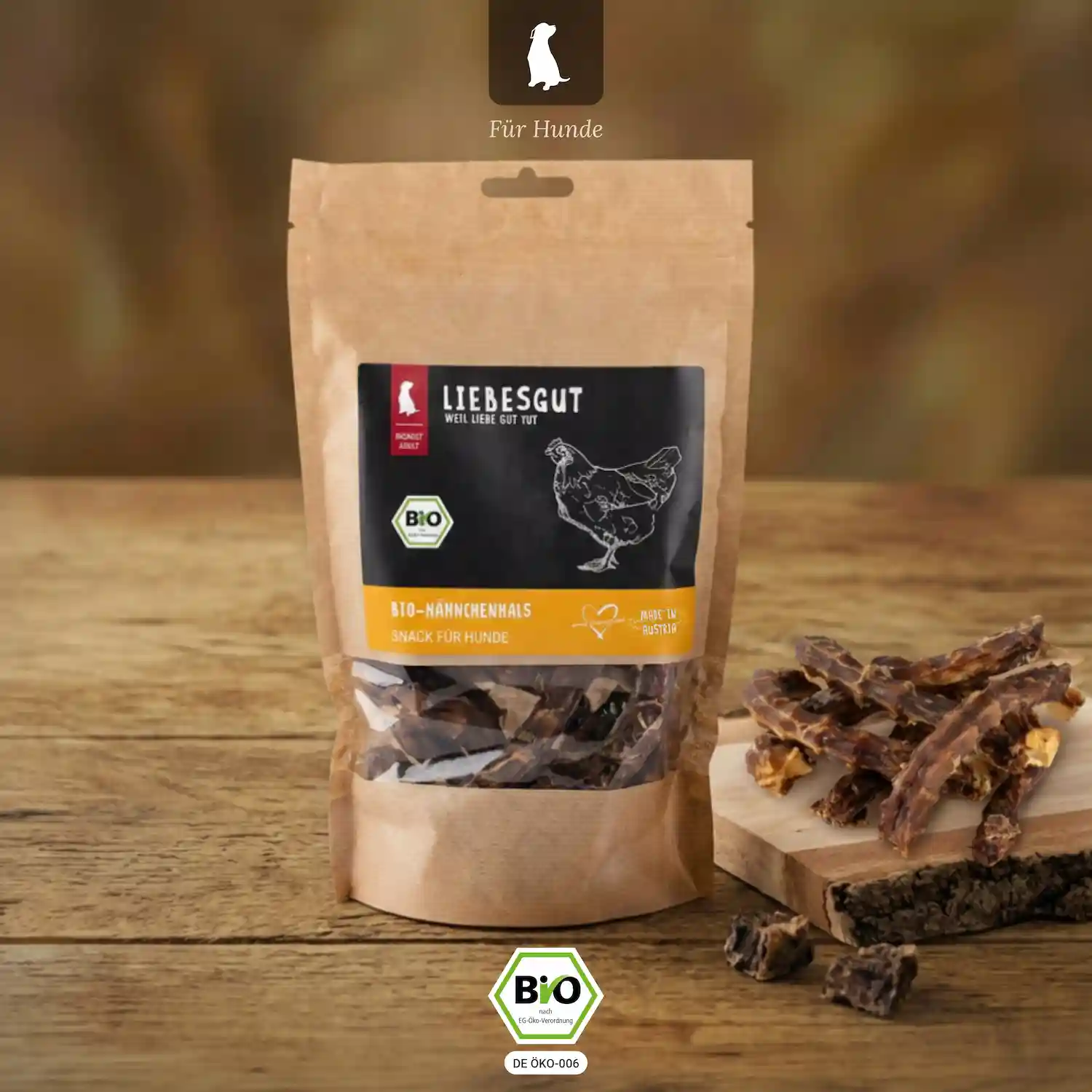
Organic snack for dogs
Contents: 0.1 kg (€39.90* / 1 kg)

Organic dog treats
Contents: 0.9 kg (€47.43* / 1 kg)

Snack for dogs & cats
Contents: 0.6 kg (€38.87* / 1 kg)
Selected for You
Bio Snack für Hunde
Contents: 0.15 kg (€40.60* / 1 kg)
Organic snack for dogs & cats
Contents: 0.9 kg (€37.94* / 1 kg)
Organic dog treats
Contents: 0.9 kg (€48.70* / 1 kg)
Organic snack for dogs
Contents: 0.9 kg (€34.78* / 1 kg)
Organic snack for dogs
Contents: 0.9 kg (€31.61* / 1 kg)
Organic snack for dogs
Contents: 0.9 kg (€34.78* / 1 kg)
Snack for dogs
Contents: 0.6 kg (€37.92* / 1 kg)
Organic snack for dogs
Contents: 0.1 kg (€39.90* / 1 kg)
Organic dog treats
Contents: 0.9 kg (€47.43* / 1 kg)
Snack for dogs & cats
Contents: 0.6 kg (€38.87* / 1 kg)