


How to get your puppy house-trained
Even if it sounds difficult at first, house-training your puppy is not that bad. Dogs are animals that like to keep their area and themselves clean and therefore do not wilfully soil the car seats or their owner and certainly not their basket. Female dogs will even clean the whelping area of their offspring until the puppy has stopped eating solid food. After that, it is not because the puppies do not want to be house-trained. They are usually still too small and have both a digestive system that is not yet fully developed and a bladder that has not yet been trained. This is why they are often taken by surprise, so that they can no longer contain themselves and mishaps can occur. But it's not difficult to show your little family member how to housebreak.
How long it takes for your puppy to be house-trained
First things first: it won't happen overnight that your puppy becomes house-trained. You will need a little perseverance and patience. It also varies from puppy to puppy as to how capable he is of learning, how quickly he gets used to it and also how quickly his body allows him to wait until you have gone outside before he is allowed to do his business. In any case, you should expect this to take up to 6 months. If the little one comes to you late and is already a few months old, during which time house-training has not been practised, it can even take up to a year.
How to recognise that your puppy needs to go outside
If you have developed a feel for your puppy in the first few days and weeks, you will soon recognise when it is time for your puppy to go out. The little one will become restless, perhaps running in circles and looking for a place in suitable corners. He will appear anxious.
Now it's time to go outside, even outside the times specified in the daily schedule. Even if you are supposed to act calmly, hurry. Take your puppy in your arms and carry him outside. Ideally, there should be a separate area right next to the house where you can do your puppy's business. However, you may have to wait because your puppy is so distracted by external influences that he forgets for a short time how urgently he needs to go. Again, patience is required on your part.
Once he has done his business, it's time for a reward. This can be a treat, a toy or simply a cuddle. Afterwards, it makes sense to leave the dog toilet area immediately and play with your little one a little further away. Then go back into the flat, where you should also spend some time with him. Praise your puppy extensively.
Define the "toilet area" for your puppy
You can offer your puppy a "toilet area" either in your own garden or in a green area directly in front of the house. All dogs, including puppies, prefer a natural place to do their business. It is often difficult for dogs to do their business on the street between concrete walls.
If you keep returning to the "green" area with your puppy, he will pick up the scent of his previous presence here. Nevertheless, it is important to keep the area clean and to dispose of any droppings. This is because, conversely, anything left lying around will deter your puppy from returning to this area. He will then look for another place.
You want to keep the garden as clean as possible. It therefore makes sense to separate the toilet area from the rest of the garden. Tree bark is particularly suitable for this. This is because it smells different to the rest of the environment and your puppy will learn the difference between the two areas: One part is intended for his business, the other for playing and romping.
Create a separate area in the home for your puppy
To ensure that you can keep a close eye on your puppy at all times, it is helpful to separate only a small area of the home for him. At times when you have other things to do, the puppy will be "fixed" there and cannot be left unsupervised in the entire flat. There are special puppy fences for this, but depending on how big the puppy is, an old playpen is also suitable, although it offers less room to move around. Of course, this is not a place for the whole day. If you have time, you can let him out and watch him.
Create a daily structure for your puppy
Recurring daily structures are important for house-training your puppy. There are different times when you can be sure that your puppy needs to go outside. Therefore, take him outside every time after eating and drinking, sleeping and every half hour when playing and running around.
It is important that your puppy can go to the toilet regularly in this way. If he does his business, he receives a reward. But even if he doesn't do his business and you go back inside after a while without having done anything, he may still need to go. He may become restless in the flat for the first five minutes and must be taken outside again immediately to avoid a mishap. It is therefore better if you are patient and stay outside with him for longer periods of time.
The regular rhythm of going outside with your puppy will help him to remember what he is supposed to be doing outside. You should bear in mind that pups under 3 months old need to be taken outside every 1.5 - 2 hours. From the 3rd to 4th month, you can allow up to 3 hours and in the 5th and 6th month it is already 4 hours. However, these are only guidelines and you must decide individually after a few days of observation how often you take your little one outside.
How to deal with your puppy's mishaps
Of course it is annoying for you if your puppy has an accident in the house. But then you need to keep calm. Punishment is useless at this moment. Your own inattention is probably to blame for the mishap. Some owners even push the puppy into its business with their nose. However, punishment in any form should be absolutely taboo. This is because the puppy will do its business in hidden corners in the future when it is no longer able to stop so that it is not punished or reprimanded again.
It makes sense to pick up the puppy as soon as you catch him "in the act" and take him outside without angry words. Praise is important if the puppy continues to do its business outside or loosens itself again.
To ensure that no odours remain in the house, not only for your own nose but also for your puppy, any droppings must be removed immediately. Otherwise, the puppy may visit the spot more often from now on. A mixture of vinegar and water neutralises the scent.
How to house-train your puppy at night
A night can be long for your puppy, even when he is sleeping. A fixed ritual helps him here too. It is helpful to always feed your puppy at the same time in the evening. You go out for the last time before bedtime, for example at 10 pm. Your puppy should definitely do his business now.
A basket that you place in a high box that the puppy cannot climb out of is suitable for your puppy's night-time accommodation. A lockable dog crate is also suitable for the night. Of course, the night quarters should be close to your bed. This way you will always know if your little one gets restless and can take him outside. The scratching and whimpering will certainly wake you up. It is helpful to position the things you need, such as shoes, keys or jacket, so that you can get them out quickly. Once everything is done in the toilet area, a reward is of course essential.
Lonely nights for the little one in a locked room, however, lead to bladder or bowel evacuation on the spot and are not helpful in getting the puppy house-trained.
Conclusion
As you can see, it's not that difficult to house-train your puppy - and in a short space of time. Offer your puppy a recurring daily routine. This will help him get used to the rituals quickly. But your own attention is also important so that mishaps don't happen in the first place. If this does happen, it is important not to unsettle the puppy and never to scold or punish him. Good housetraining is always based on your own calmness and the puppy's absolute trust in you.
Our recommendations for your four-legged friend:
Selected for You

Organic dog food junior
Contents: 2.4 kg (€9.48* / 1 kg)
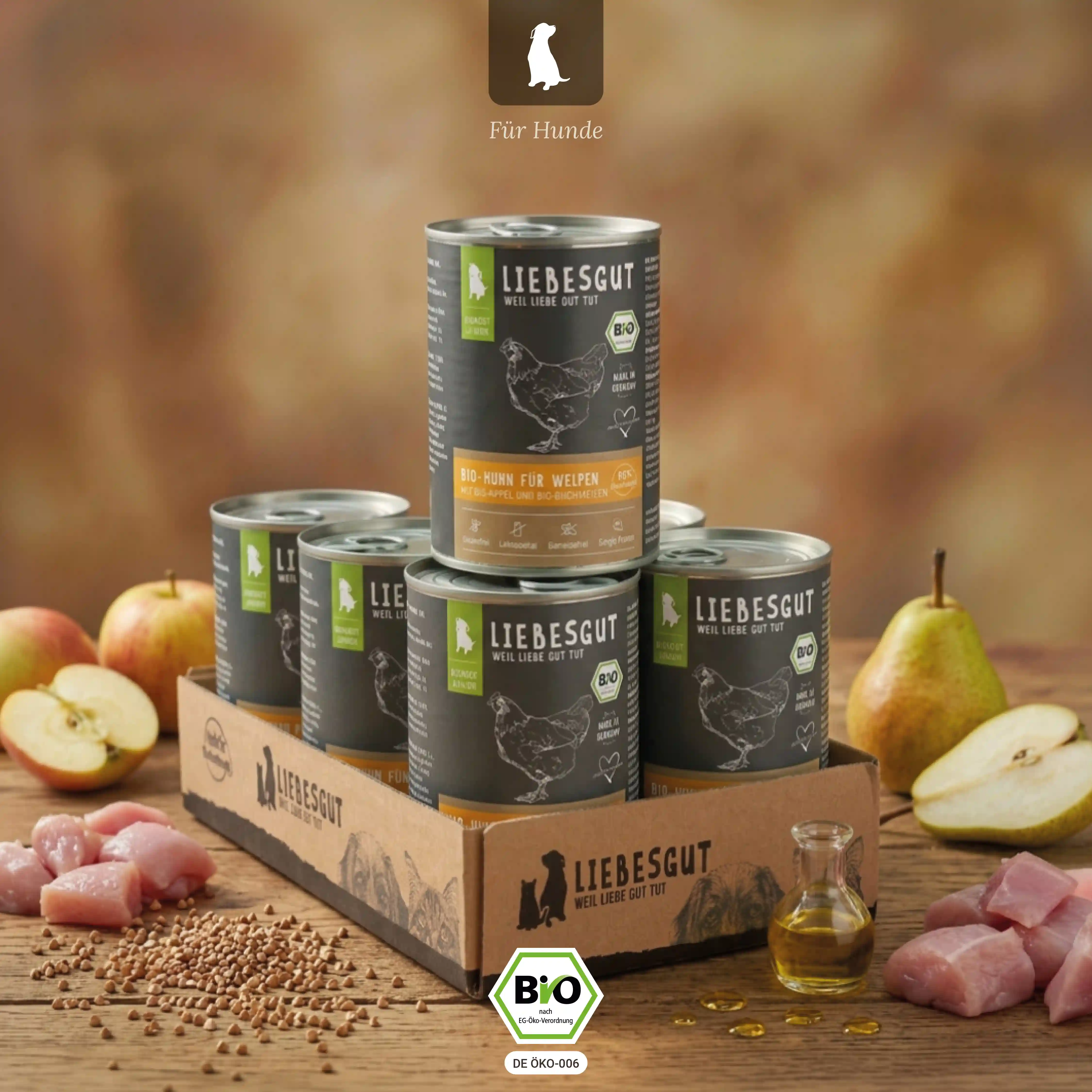
Organic dog food junior
Contents: 2.4 kg (€9.23* / 1 kg)

Organic dog food junior
Contents: 2.4 kg (€8.98* / 1 kg)
Selected for You
Organic dog food junior
Contents: 2.4 kg (€9.48* / 1 kg)
Organic dog food junior
Contents: 2.4 kg (€9.23* / 1 kg)
Organic dog food junior
Contents: 2.4 kg (€8.98* / 1 kg)