


Nutritional counselling for puppies
From when to when should the Junior line be fed?
The Liebesgut Junior line is suitable from around 4 weeks of age. The puppy should be fully accustomed to the food by around the 8th week, as most dog mothers wean their children off their mother's milk from this point onwards and withdraw.
Until when the junior food can be fed depends strongly on the breed: Medium breeds grow on average around 12 months, very small breeds can be fully grown by 6-8 months. Giant breeds can grow for up to 1 ½ years.
From 2-3 months before reaching adulthood, if the animal has already developed well, it can also be partially or completely switched to our adult line. Particularly with very large breeds, the switch can be made relatively early to prevent overly rapid growth.
Why is it important to avoid overweight and rapid growth in puppies?
If the animal consumes too much energy over a long period of time, this can have serious consequences: Excess weight puts too much strain on the puppy's young skeletal system. The bones and joints are not yet fully developed and are impaired in their further development by additional weight. This can lead to chronic joint disease, which the dog then has to live with for the rest of its life. Very large breeds in particular, which can grow very quickly in a very short space of time, are at risk. If there is an oversupply of energy due to excessive feeding, the skeleton grows relatively quickly and the storage of calcium does not keep pace with this process. Possible consequences can be injuries to the joint cartilage and growth zones.
It is therefore advisable to establish a growth curve for the puppy at a very early stage. Ideally, this should be done in co-operation with the vet. For a growth curve, the weight of the puppy and the same-sex parent animal are entered in a diagram. The vet can determine in which range the animal's development should be at which point in time. If the actual values are below or above the defined range, this can be counteracted with appropriate feeding.
What to do if the puppy stops eating?
There are two cases here:
Case 1: If the animal refuses to eat when switching from mother's milk to solid food, different flavours can be tried. If the animal consistently refuses to eat, a vet should be consulted to rule out possible illnesses.
Case 2: If a puppy has already accepted a food and suddenly stops eating it, this may also be related to the young animal's defiant phase. This is similar to the behaviour of humans during puberty. The limits are tested. Here the dog tries to influence the owner. If you give in to this, the puppy may get used to it and realise that it will get a particularly tasty meal if it refuses to eat. In the worst case scenario, this behaviour can then continue throughout the puppy's entire life. It is important to remain consistent here. As soon as a dog is really hungry, it is unlikely that it will starve before the bowl is full.
But be careful: if the animal seems generally lethargic, a vet should be consulted. Abnormalities in the oral cavity and a refusal to eat over a longer period of time should also not be taken lightly. It is always better to visit the vet once too often than once too little.
What is the nutritional requirement for puppies?
The nutrient requirement can be up to 2.2 times the maintenance requirement at around 3 months and up to 1.7 times the maintenance requirement from 7 months.
Protein, calcium and phosphorus in particular are needed in the first few months of growth. Fats are not only a source of energy, they also provide the body with essential (vital) fatty acids, enable the absorption of fat-soluble vitamins and, last but not least, improve the flavour of the food.
How often should a puppy be fed?
Immediately after weaning from their mother, puppies are used to being fed on demand. In this phase, food should be provided as much and as often as the dog can eat quickly (3-4 times a day). From the 6th month onwards, fixed feeding times should be introduced and meals should be limited to two rations. The fixed times mean that the dog knows when to eat, produces more saliva and the digestive system adapts to the task ahead.
Our recommendations for your four-legged friend:
Selected for You
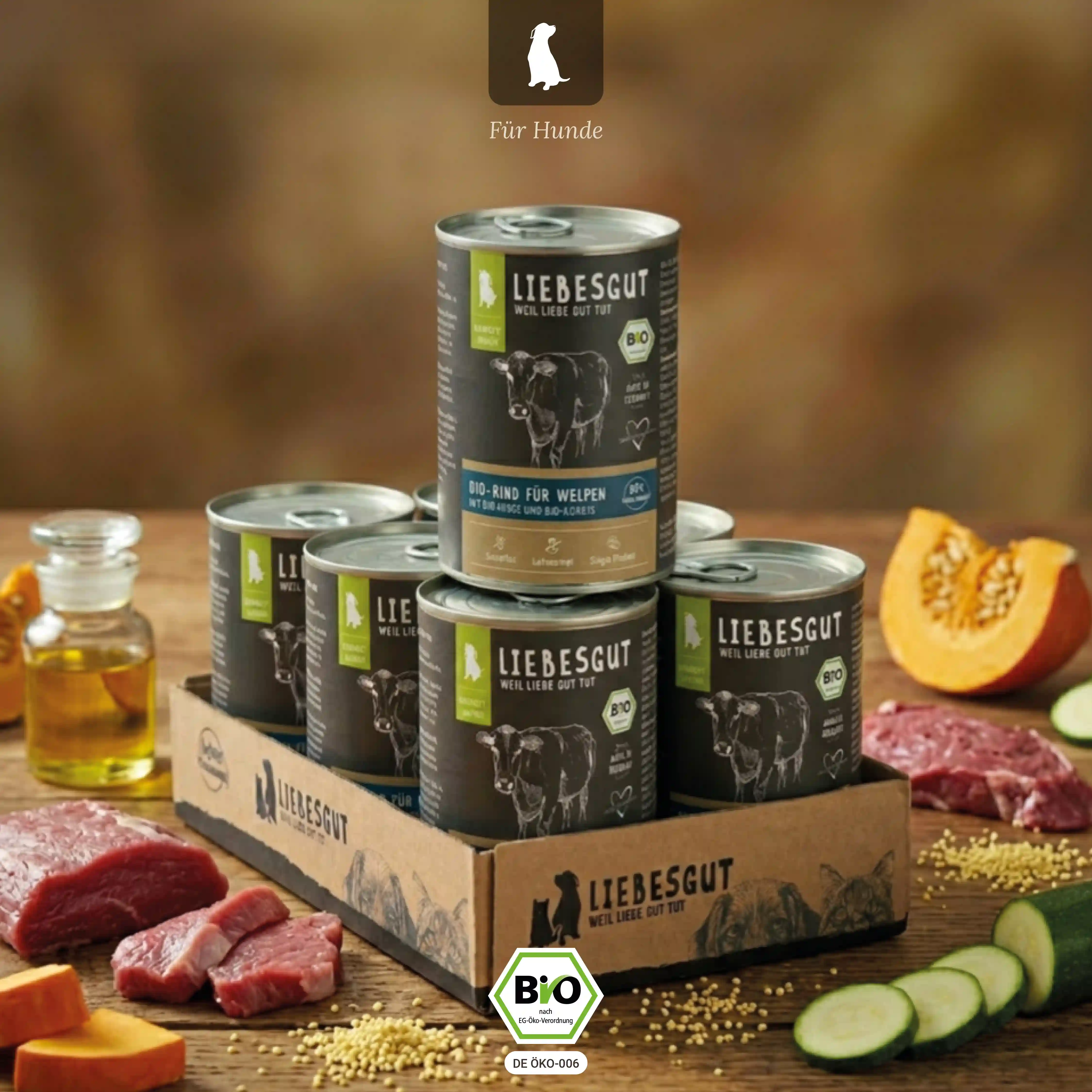
Organic dog food junior
Contents: 2.4 kg (€9.48* / 1 kg)
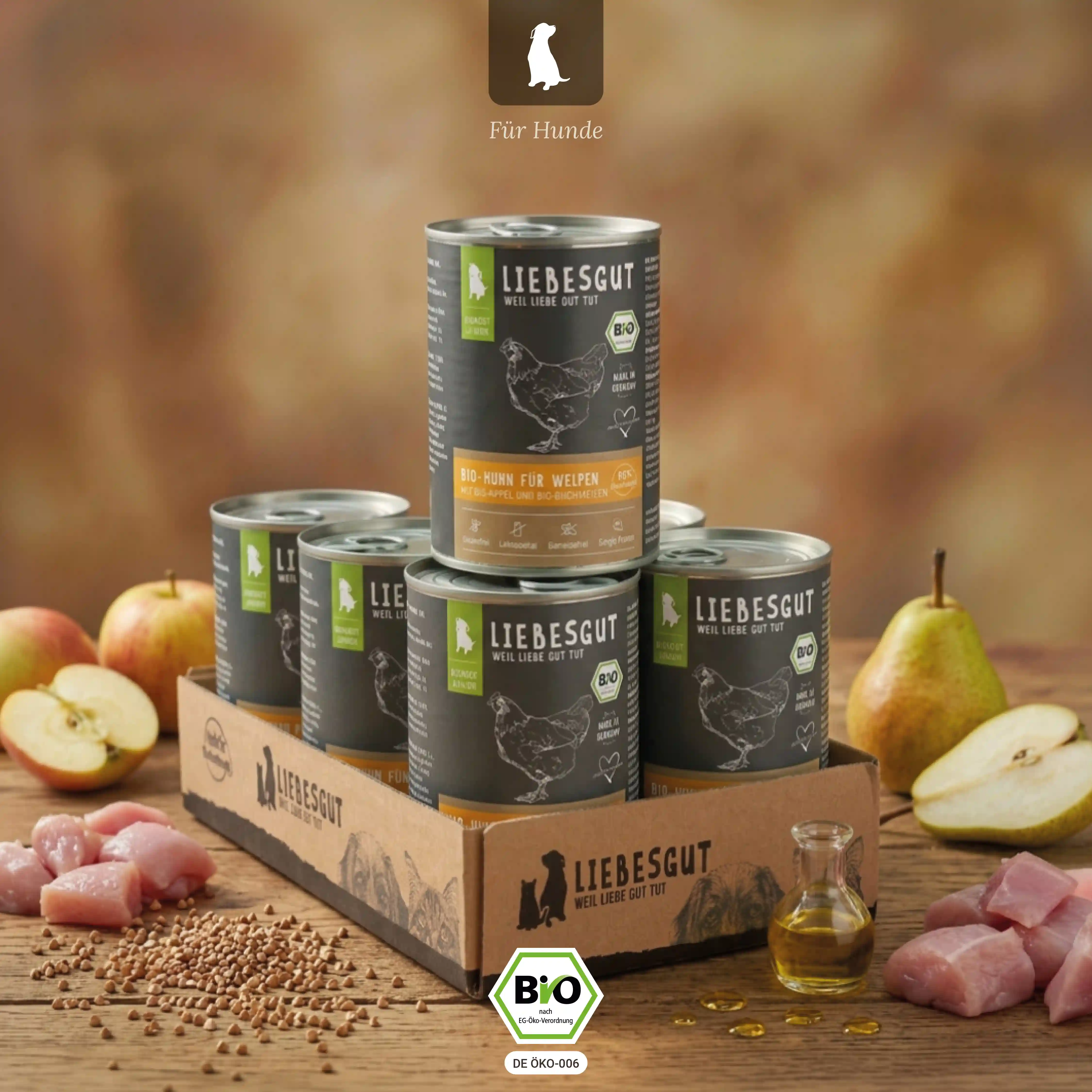
Organic dog food junior
Contents: 2.4 kg (€9.23* / 1 kg)
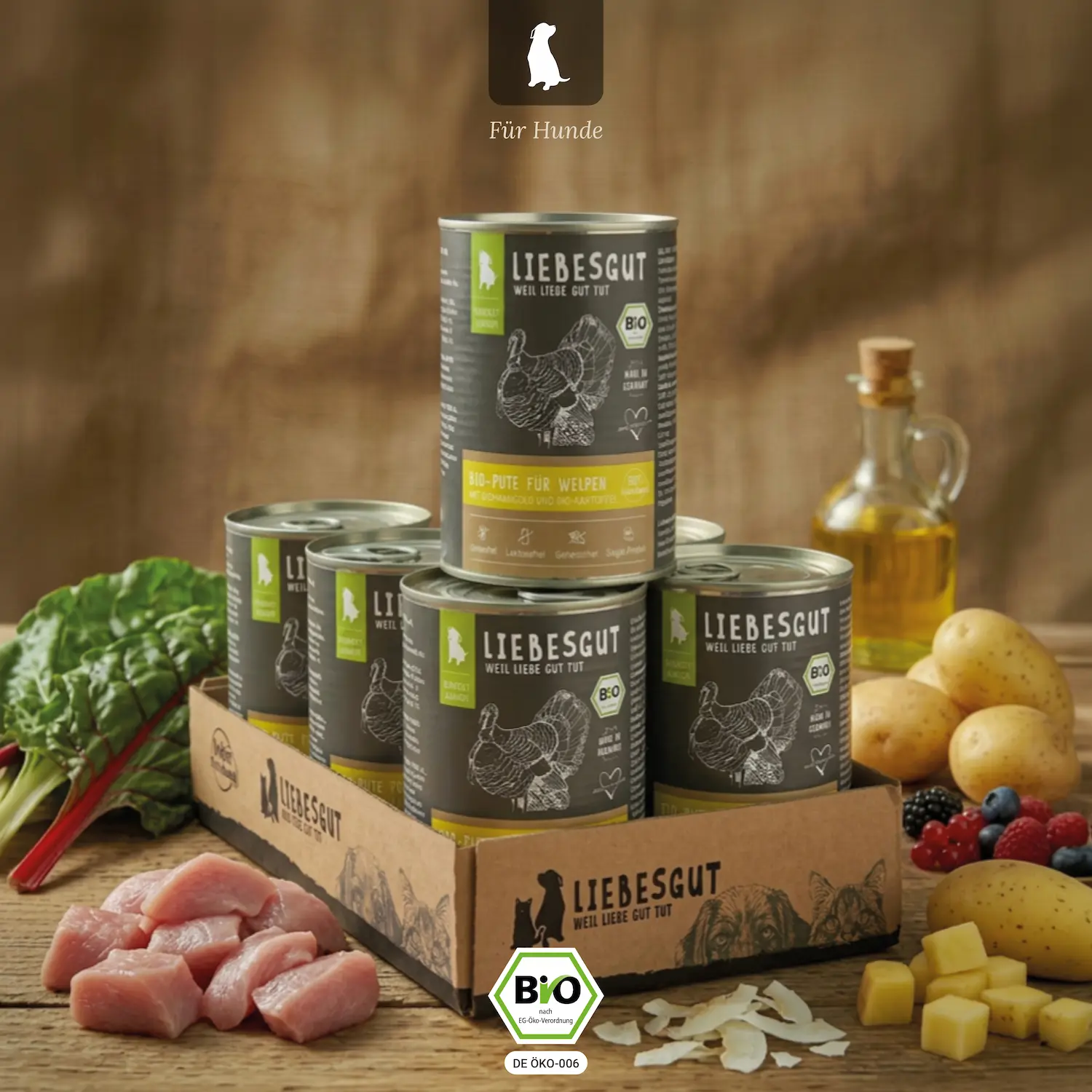
Organic dog food junior
Contents: 2.4 kg (€8.98* / 1 kg)
Selected for You
Organic dog food junior
Contents: 2.4 kg (€9.48* / 1 kg)
Organic dog food junior
Contents: 2.4 kg (€9.23* / 1 kg)
Organic dog food junior
Contents: 2.4 kg (€8.98* / 1 kg)