


Nutritional advice for kittens
From when to when should the junior line be fed?
Ideally, a mum cat should suckle her offspring for as long as possible. There is nothing better for kittens than feeding on mother's milk together with their siblings. In the fourth week of life, however, the number of suckling acts is reduced. Depending on the number of kittens and the physical condition of the mother, "solid" food should be offered from this point at the latest. If this is accepted, you should reduce the amount of liquid for the mother accordingly in order to slowly reduce milk production and prevent milk retention.
When the kittens reach sexual maturity, you can switch to adult food. Sexual maturity depends on the breed, approx. 7-12 months of age.
What are the nutritional requirements of kittens?
At the age of ten to twelve weeks, the energy, protein and vitamin requirements of young kittens are very high. By the time they reach sexual maturity, the requirement for certain nutrients can be up to twice as high. Calcium in particular is needed for bone formation.
The body's main building blocks are protein and fatty acids. The food should therefore contain plenty of high-quality animal protein. Animal protein is particularly important for young cats, as it contains the amino acids required to build their bodies. To ensure that as many amino acids as possible can be absorbed, the protein should also be highly digestible.
Cats can only synthesise small amounts of taurine themselves and in the wild this is obtained from fresh meat (e.g. mice). Taurine is required for digestion and the retina and prevents numerous diseases. A deficiency can lead to organ damage and blindness. Supplying cats with taurine from outside is therefore essential.
How often should a kitten be fed?
As often as the kitten requires food. This is particularly recommended shortly after weaning from mother's milk. A cat usually knows when it has had enough. And it really needs a lot of energy. This is because its body performs at its best in the first few weeks and months. Within this short time, the kitten multiplies its weight and size, its bones, organs and muscles grow and its immune system matures completely. In the last quarter of the growth phase, it should be slowly regulated to 3-4 meals a day.
What to do if the kitten doesn't eat?
If you got the kitten from the breeder, it is a good idea to give it the same food that the breeder used to wean the kitten from its mother. Such a small cat is still very fixated on its first food. You can then slowly change the food over the course of two weeks. To do this, first add a small amount of the new food to the usual food, then larger and larger amounts until it finally consists of 100% of the new food.
Kittens are also used to lying down and stretching their heads upwards from suckling. Now they should put their head down into a bowl. This can be confusing at first. It is best to offer a little food with a spoon and lure the head towards the bowl. A slight downward pressure with your hand won't hurt either, but don't use force! The feeding place may also be unsuitable. Cats prefer a quiet place where they can eat undisturbed. And this should not be right next to the litter tray.
If the kitten consistently refuses to eat and does not put on weight or even lose weight, you should definitely consult a vet.
Is it bad if the mum cat also eats?
Not at all during certain phases. In the last third of pregnancy, during suckling and 2-3 weeks after the kittens have been weaned, mum is welcome to eat our Junior line too! The protein and mineral-rich food is not only good for the fast-growing fur balls during these phases. Mummy cat is also under a lot of strain from pregnancy and breastfeeding and may be draining her reserves. But please don't give the food for too long, otherwise the new mum may soon be struggling with obesity.
Our recommendations for your four-legged friend:
Selected for You
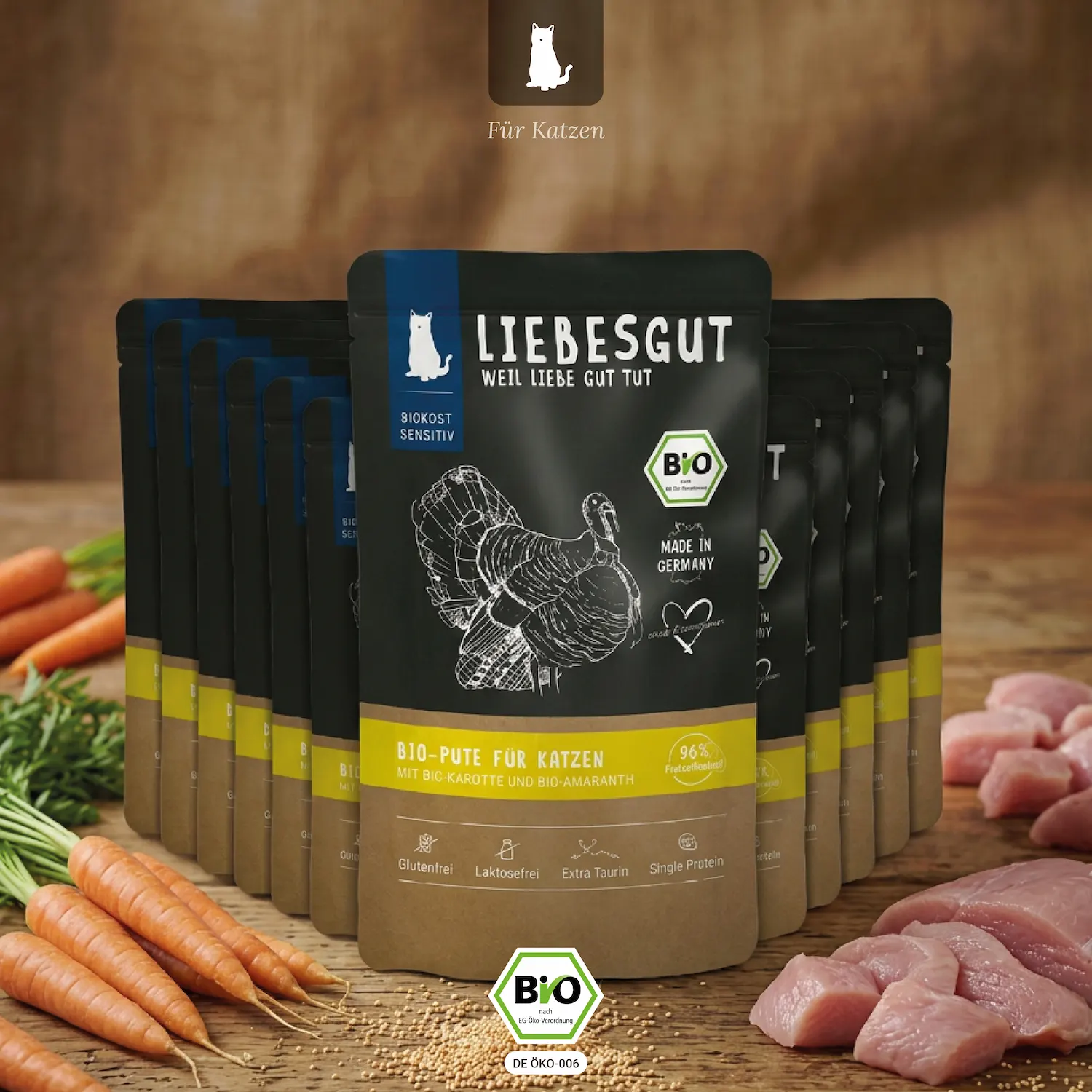
Sensitive organic cat food
Contents: 1.2 kg (€15.91* / 1 kg)

Sensitive cat food
Contents: 1.2 kg (€17.91* / 1 kg)

Sensitive cat food
Contents: 0.8 kg (€13.01* / 1 kg)
Selected for You
Sensitive organic cat food
Contents: 1.2 kg (€15.91* / 1 kg)
Sensitive cat food
Contents: 1.2 kg (€17.91* / 1 kg)
Sensitive cat food
Contents: 0.8 kg (€13.01* / 1 kg)