


Nutritional counselling for ageing dogs
When should you feed the Sensitive line?
This Sensitive line is suitable for dogs with digestive problems, illnesses and food allergies. As these symptoms often occur with ageing, the Sensitive line is also very suitable for senior dogs.
Depending on the breed and size, the ageing process begins around the age of six to eight. Although it cannot be stopped, the accompanying symptoms can be slowed down with the right food. A dog's ageing can be recognised by the fact that it becomes more comfortable and calmer, its increasingly ageing joints require more rest, the cardiovascular system becomes more vulnerable, muscles, eyesight, hearing and sense of smell deteriorate. Their skin also becomes flabbier, their coat loses its lustre and their hearing and sight no longer work as well. As the dog slows down in old age, it also consumes less energy, the gastrointestinal tract and digestion become slower and the kidneys are also less active. To keep your dog healthy and fit, an adapted senior diet is very important.
An allergy occurs when the immune system overreacts. The proteins contained in the food are usually the cause of the problem. That is why the Liebesgut Sensitiv line uses animal species that are very well tolerated by most animals with an allergy. This is because more and more dogs are suffering from digestive problems. These result in symptoms such as vomiting, flatulence and diarrhoea. These complaints are often caused by poor quality raw materials in the food or an allergy to certain ingredients (beef, poultry, wheat). Care should be taken to ensure a good supply of high-quality proteins and low-fat feed. Excessive amounts of minerals are harmful to digestion and organs such as the kidneys and liver.
How much and how often should older dogs be fed?
It is very difficult to recommend how much to feed older dogs in particular. Senior dogs can be very sluggish or still very active. It is best to check the dog's weight regularly to determine the optimum requirement. In old age, food can be offered more often than twice a day. Animals often find it difficult to eat larger quantities at once. Dental problems or problems with the gums are also common in old age, which makes eating even more difficult. The flow of saliva also decreases. It is therefore important to offer plenty of fresh water.
Which variety of the Sensitive line is suitable for which dog?
Goat, venison and horse are very high-quality protein sources that are highly acceptable to dogs with digestive problems. By omitting liver, the mineral content is kept low. The fat content is far lower than the protein value, which aids digestion. Most older dogs and dogs with digestive problems are also not very active, so obesity must be prevented.
Organic goat with sweet potato and courgette: Goat meat is very lean and a high-quality protein. This variety is therefore well suited for seniors who sleep a lot and whose urge to exercise has greatly diminished.
Venison with organic fruit and millet and horse with organic courgette and carrot:
Two very high-quality types of protein that can help with digestive problems. If the dog has already lost weight due to an allergy or digestive problems, these varieties are preferable. Compared to the goat meat variety, these have a slightly higher fat content. This means that slightly emaciated animals can be gently fed again.
Feeding in summer?
Your pet's diet, whether dog or cat, depends not only on its size, age and health, but also on the weather. It therefore makes sense to change your pet's diet during the warm summer months.
Not only does the animal need more water than usual, it also has a reduced energy requirement.
Therefore, the amount of food should be reduced on persistently hot summer days and the supply of water increased at the same time. This is because dogs and cats do not like to move around in warm temperatures, especially not in the blazing sun. They prefer to look for a cool, shady spot and doze off there. Their owners can now either feed them less or switch to a lower-energy food. However, as a change of food is often tedious and sometimes also harbours risks - e.g. it can upset the digestive system and lead to upsets - a reduction in the amount of food is usually preferable.
Above all, it is important that the animal is offered water as often and as much as possible. Cats in particular, but also dogs, cool themselves by licking their fur. The evaporation of saliva cools the body, but the body also loses fluids.
Dogs pant to cool down. This involves exhaling through the mouth, which causes significantly more air to circulate in the so-called "dead space" between the windpipe and the oral mucosa, which does not even reach the animal's lungs. During panting, evaporative heat is extracted - similar to human sweating - which causes the dog's body temperature to drop. This method also causes the body to lose a lot of fluid. Therefore, wherever possible, provide water for the animal and change it regularly. Especially in the hot season, there is a risk of the water becoming mouldy or flies laying their eggs in it, which could transmit diseases.
Long-haired breeds in particular will thank you for this: An extra focus on coat care! The more often you brush the loose hair out of the coat, the lighter it becomes. This can significantly reduce the heat load. Even masters and mistresses like to get a summer hairstyle in spring.
But no matter how hot it is, food and water should always be at room temperature so that they are good for your dog or cat.
Calcium / phosphorus: function and ratio in dog food?
The dog's organism contains approx. 10-15g calcium/kg body mass (BM), 98% of which is found in the skeleton. The proportion of phosphorus (5-8g/kg body mass) deposited in the skeleton is around 80%. This distribution indicates the important function of both minerals for the stability and function of the skeleton. Beyond this, however, the functions of the two elements are different.
The amounts of Ca and P deposited in the bone have metabolic and functional tasks. While the metabolically active components are located in the immediate vicinity of the blood vessels and are in active exchange with the blood, the functional quantities ensure the mechanical stability of the bone.
For adult dogs, a daily intake of approx. 80mg calcium and 60mg phosphorus per kg body weight is sufficient to maintain the Ca and P levels in the organism, even for older animals or under particularly stressful conditions. Intensive exercise does not increase the requirement.
In puppies, the total requirement is determined by the growth rate and the Ca and P intake in the various months of life. It is particularly high in the first 3 months due to the increased skeletal growth and the increasing mineralisation of the bones. Large breed puppies still have a high requirement in the 4th to 6th month of life.
The calcium-phosphorus ratio is so important because an oversupply or undersupply of one of the two minerals can lead to deficiency symptoms. For example, too much phosphorus would inhibit calcium absorption and, conversely, too much calcium would deprive the body of phosphorus. Depending on the age of the dog, a Ca:P ratio of 1:3 to 2:1 should be maintained in the feed. Moderate deviations from these ratios are tolerated without disadvantages if the absolutely necessary quantities are available. Stronger deviations (below 1 : 1) are to be avoided.
In Liebesgut pet food, the amount of calcium and phosphorus is regulated by the ingredients. In order to achieve a balanced ratio, we use special ingredients depending on the animal species. For example, neck or carcass is added to varieties with poultry meat. The poultry components have a higher Ca and P content than pure breast meat. For varieties with e.g. organic beef or sheep, ground eggshell is added to the feed, as this also contributes to a higher mineral content. We consistently refrain from using animal or bone meal to regulate the mineral balance.
Our recommendations for your four-legged friend:
Selected for You
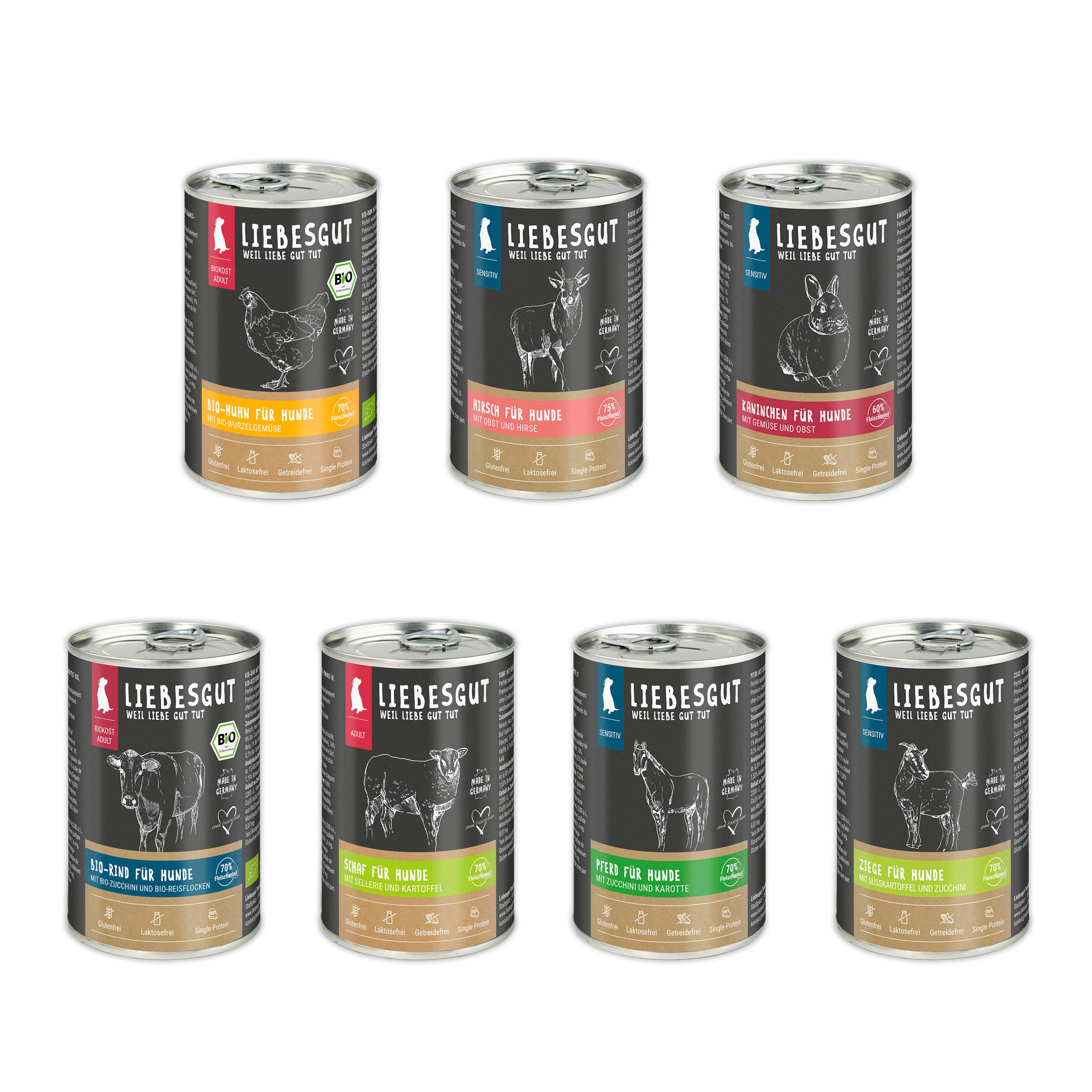
Adult & Sensitive dog food
Contents: 5.6 kg (€9.17* / 1 kg)

Adult & Sensitive dog food
Contents: 11.2 kg (€7.91* / 1 kg)

Adult dog food
Contents: 2.4 kg (€9.08* / 1 kg)

Adult dog food
Contents: 4.8 kg (€7.59* / 1 kg)
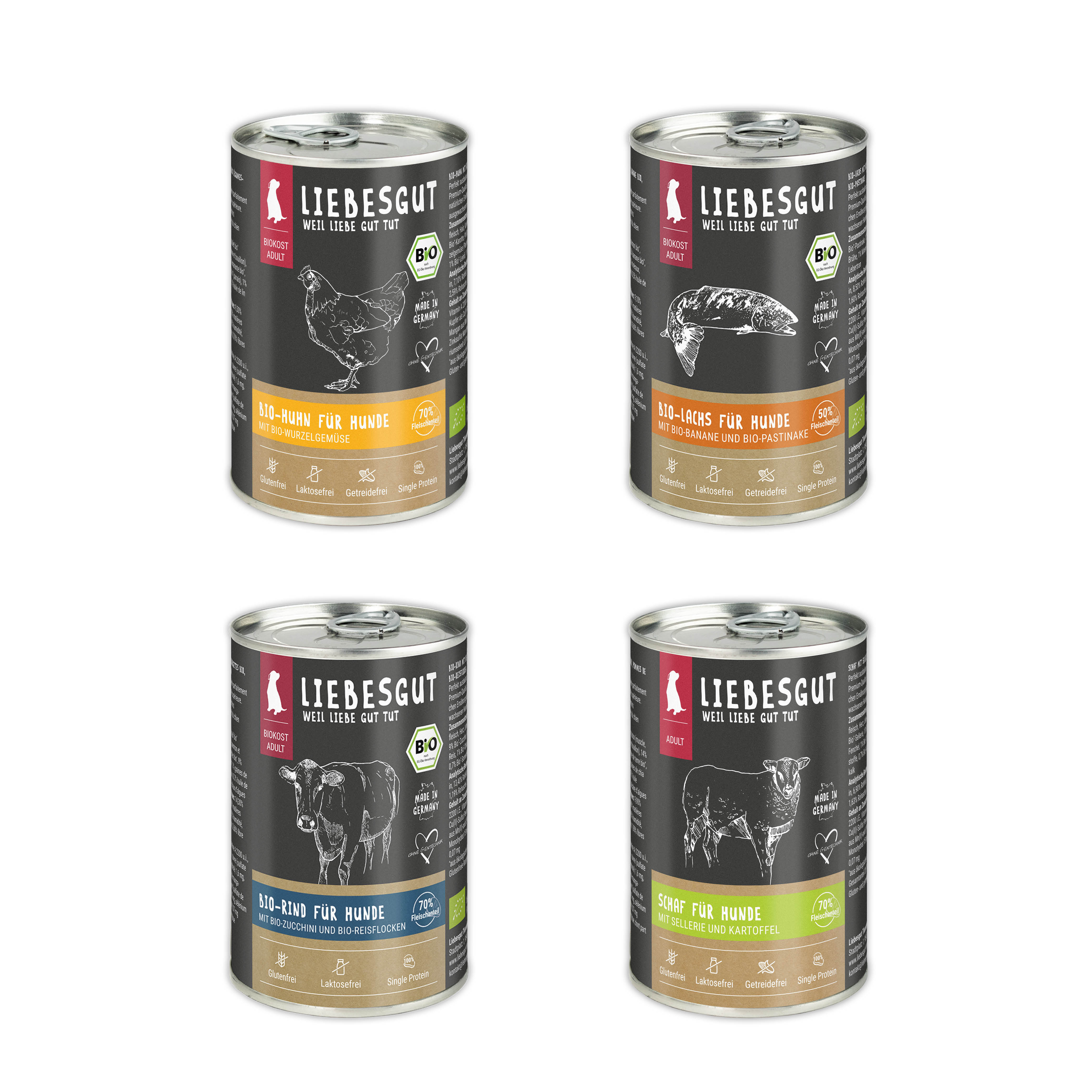
Adult dog food
Contents: 3.2 kg (€9.12* / 1 kg)
Selected for You
Adult & Sensitive dog food
Contents: 5.6 kg (€9.17* / 1 kg)
Adult & Sensitive dog food
Contents: 11.2 kg (€7.91* / 1 kg)
Adult dog food
Contents: 2.4 kg (€9.08* / 1 kg)
Adult dog food
Contents: 4.8 kg (€7.59* / 1 kg)
Adult dog food
Contents: 3.2 kg (€9.12* / 1 kg)