


Clicker fun with dogs and cats - how to get started
Clicker training is a training method based on the findings of behavioural research. A specific marker signal (the click) and an associated reward motivate the animal to perform a specific behaviour. Clicker training is based on positive rewards and does not involve any punishment.
Why the clicker?
You're probably wondering why you can't simply give praise or a treat as a reward when your dog or cat has done something great. Of course, this is also possible and your four-legged friend will be happy about it, but you will achieve faster learning success with the clicker. This is because the click marks exactly the behaviour you want to reward. You take a photo of the situation, so to speak. The click also works over long distances. The dog and cat know at that precise moment that something great is about to happen. They are in a good mood even before the reward is given.
A clicker is also a clear and unmistakable signal. Unlike your voice, which your dog or cat hears all the time and in different situations.
Tip: For deaf animals, a light beam from a torch or a vibration signal (tapping the floor once with your hand or stamping lightly with your foot) can be used instead of a clicker.
Introducing the clicker
In order for your four-legged friend to understand the principle, you must first introduce the clicker and show your pet that this sound means: "Here comes something really great!". This is known as "classical conditioning". If your pet is food-motivated, you will probably have no problem with this. Find out which treat your dog or cat likes best. Our mini organic treats for dogs and cats, for example, are a great reward. They are just the right size so that you can reward them quickly and easily. If your pet is not so keen on food, you can also offer their favourite toy, a cuddle or brushing. Once you have found the right reward, you can start clicker training.
Here we go
- Count out 10 to 20 treats and put them in a treat bag.
- Make sure your environment is free of distractions: switch off the radio and TV, close the windows and mute your mobile phone.
- Hold the clicker in one hand. The other is still hanging down loosely.
- If your pet is not already with you, call it to you now.
- Now click once and give the treat immediately. The reward should follow immediately after the click. If it takes too long, the link will not be established.
- When the treats have been used up, show your empty hands and say a final word, for example "Done".
After about three to four rounds, most animals will have understood how the principle works. You can test this by clicking while your pet is slightly distracted. If it then immediately looks at you or the hand with the clicker, it has understood what the click means.
Tip: The right timing is important when clicking. You should catch the exact moment when your pet shows the right behaviour, for example when it sits down. You can practise the timing with a partner: They bounce a tennis ball on the floor and you click exactly when the ball hits the floor. Alternatively, your partner can throw the ball into the air and you click at the highest point.
First exercises
Has your dog or cat understood what the click means? Great, then you can now start with the first exercises.
There are various training methods for rehearsing a certain behaviour:
- "Capturing", i.e. "catching" a behaviour: Here you observe your dog or cat and click at the exact moment when the desired behaviour is shown.
- "Shaping" a behaviour: This involves taking your pet closer and closer to the desired behaviour in small steps. You will often use both methods to train a behaviour.
Nose-to-tail
An important first exercise is the "nose touch": your pet touches your finger or a so-called target stick with its nose. At the exact moment the nose touches the target, the dog or cat clicks and is rewarded. You can then use the target stick or finger to guide your dog or cat to certain places or through a course.
Sit
Wait until your dog or cat sits down on its own. Click at the exact moment your pet sits down. Give the reward so that it has to stand up again. Then wait for the next sit.
Wait
An important exercise. Your pet must always sit quietly and wait a little longer before the click comes. This is a difficult but useful exercise, especially for young and impatient animals.
You can find more ideas and exercises online or in a book on clicker training.
Introduce hand signals or word signals
If your pet shows a behaviour reliably, you can introduce a hand signal or word signal, for example "Sit" or "Sit":
- If your pet already sits down reliably on its own, click as usual, but now you also show your hand signal or say the signal word before giving the reward.
- After several repetitions, in the next training step you first give the signal while your pet sits and click immediately afterwards.
- A few sessions later, give the signal first and wait until your pet sits down. Only then do you click and reward.
Troubleshooting
If your pet doesn't want to join in or stops the training, check the general conditions again:
- Is it the right treat/reward?
- Is your pet distracted?
- Does your pet have other needs at the moment?
- Was the exercise too difficult?
- Or is your pet already bored because the exercise is too easy?
- Is your pet really already conditioned to the clicker?
If an exercise just won't work, try breaking it down into small intermediate steps. Or think about how you can approach it in a completely different way.
Still looking for the perfect reward? Our organic treats for dogs and cats consist almost entirely of high-quality meat. They are sugar-, lactose- and gluten-free and free from antibiotics, colourings and preservatives. So you can reward your pet with a clear conscience.
Our recommendations for your four-legged friend:
Selected for You

Organic dog treats
Contents: 0.9 kg (€47.43* / 1 kg)
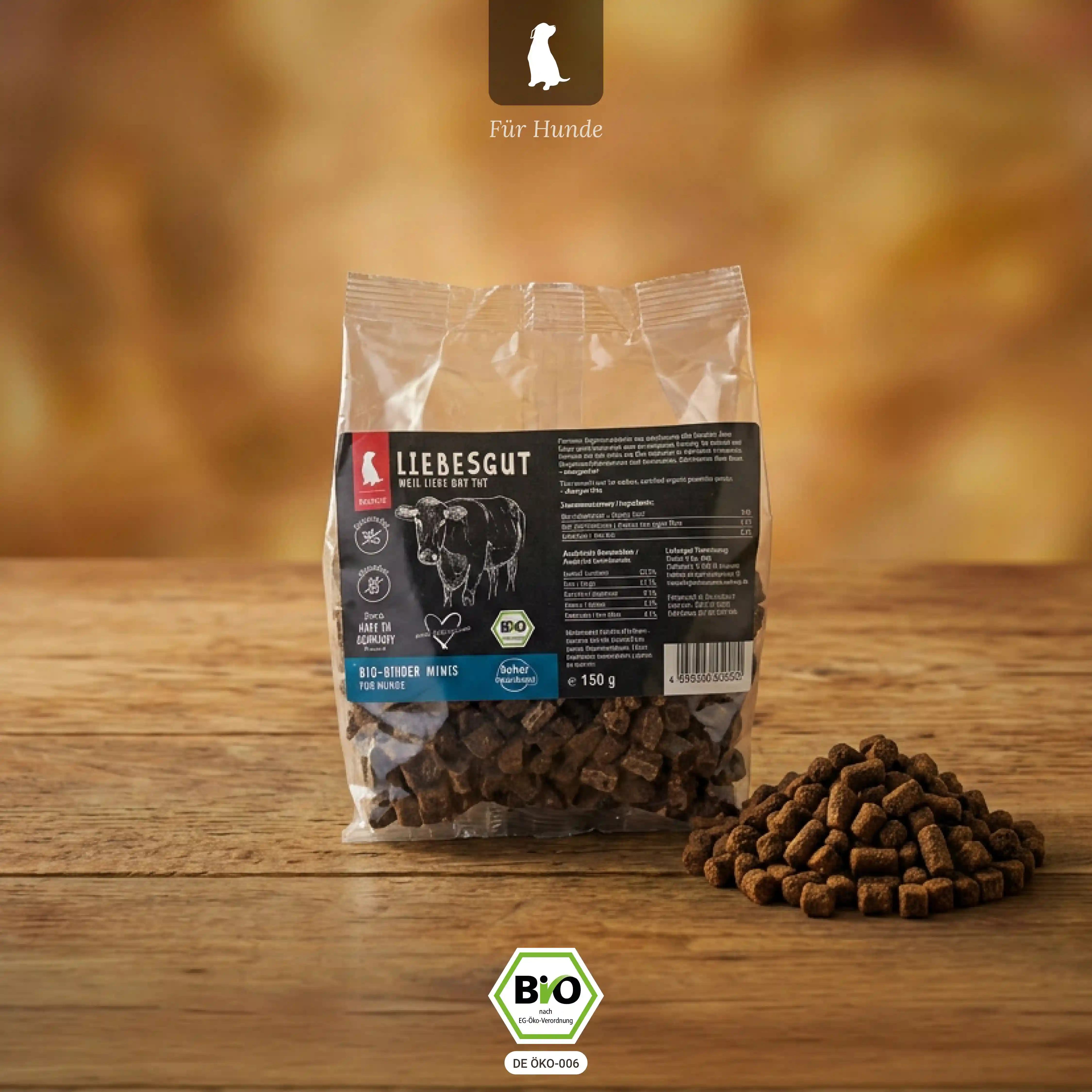
Organic dog treats
Contents: 0.15 kg (€51.27* / 1 kg)

Organic cat treats
Contents: 0.48 kg (€61.65* / 1 kg)

Organic cat treats
Contents: 0.48 kg (€62.40* / 1 kg)
Selected for You
Organic dog treats
Contents: 0.9 kg (€47.43* / 1 kg)
Organic dog treats
Contents: 0.15 kg (€51.27* / 1 kg)
Organic cat treats
Contents: 0.48 kg (€61.65* / 1 kg)
Organic cat treats
Contents: 0.48 kg (€62.40* / 1 kg)